
WALK FOR TRUTH
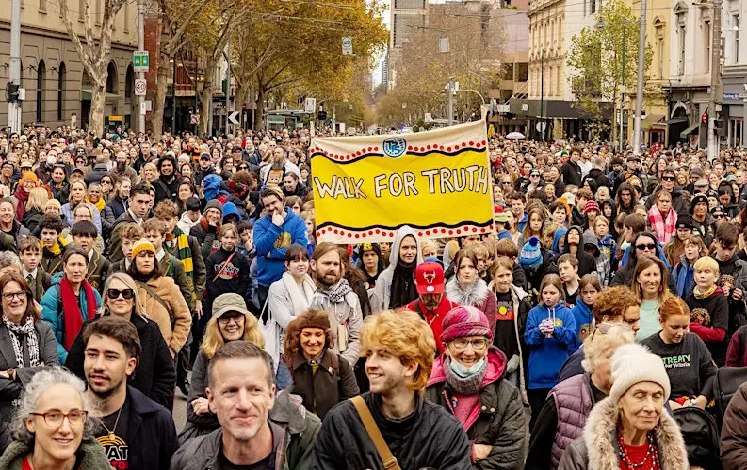
Image: Darebin Climate Action Now, Facebook
Kerrupmara Gunditjmara man Travis Lovett has embarked on an 820-kilometre Walk for Truth, leading a large group from the steps of the Victorian Parliament House in a powerful act of advocacy for national truth-telling and healing.
The walk, which has drawn community members and supporters along the way, reached Dights Falls Park in Melbourne, where participants gathered with Wurundjeri Elders for a ceremony on Country, marking both a cultural and symbolic moment in the journey.
Lovett, a former commissioner with the Yoorrook Justice Commission, is expected to arrive at Parliament House, Canberra on Ngunnawal and Ngambri Country on May 27. At the conclusion of the 39-day journey, he will deliver a letter to Prime Minister Anthony Albanese calling for the establishment of a properly resourced, legislated, and nationally coordinated truth-telling process led in genuine partnership with First Peoples.
The letter reflects a broader message at the heart of the Walk for Truth: that Australia’s national story remains incomplete without confronting the ongoing impacts of colonisation, including dispossession, frontier conflict, the Stolen Generations, and the lasting effects of past policies on Aboriginal and Torres Strait Islander communities.
Speaking to National Indigenous Times, Lovett said invitations had been extended to politicians across the country to join the walk and take part in the process firsthand. He also directly encouraged the Prime Minister to engage not only at its conclusion, but throughout the journey itself.
“We extend that invitation to the Prime Minister to come and walk with us,” Lovett said. “Not to wait until the end, but come and walk with us on this journey. Come and listen, learn and engage with our people about our lived experience, about the injustices our people have experienced. But also, the strength, the resistance, and the contributions that our people continually make to this nation.”
The Walk for Truth has been framed by organisers and participants as both a physical journey across Country and a collective act of reflection. It honours those who carried truth without recognition, those who did not live to see justice acknowledged, and future generations who deserve a more honest national narrative.
Rather than a single event, Walk for Truth is understood as part of a broader and ongoing movement. It brings together walks, community gatherings, and cultural exchanges that vary in location and timing, shaped by First Peoples leadership and community priorities. Its purpose is not symbolic alone, but sustained engagement with truth-telling as a national responsibility.
Central to the movement is the belief that truth-telling is not about assigning blame, but about creating space for healing, recognition, and national repair. It calls for Aboriginal and Torres Strait Islander histories and lived experiences to be understood not as peripheral to Australia’s story, but as foundational to it.
Advocates involved in the walk argue that meaningful truth-telling must extend beyond short-term inquiries or archival documentation. Instead, it requires long-term commitment embedded across education, policy, public institutions, and civic life—supported at a national level and guided by First Peoples.
The letter to the Prime Minister also invites broader public participation in that process, urging Australians, including political leaders, to remain engaged even when the conversations are difficult. In this framing, truth-telling is positioned as an act of responsibility and care for country—one that strengthens the nation through honesty rather than avoidance.
As the Walk for Truth continues toward Canberra, it carries with it both a call and a challenge: to walk together toward a shared understanding of history, and to ensure that truth is not treated as an endpoint, but as the beginning of lasting change.